Trade
Goods still pay the border; services still pay the rent
Britain’s external accounts remain a services surplus sat on a goods deficit. Non-tariff frictions have not faded with familiarity. Reset talk is cheaper than a veterinary agreement.

Nairn Voss
Labour and fiscal correspondent · · 11 min
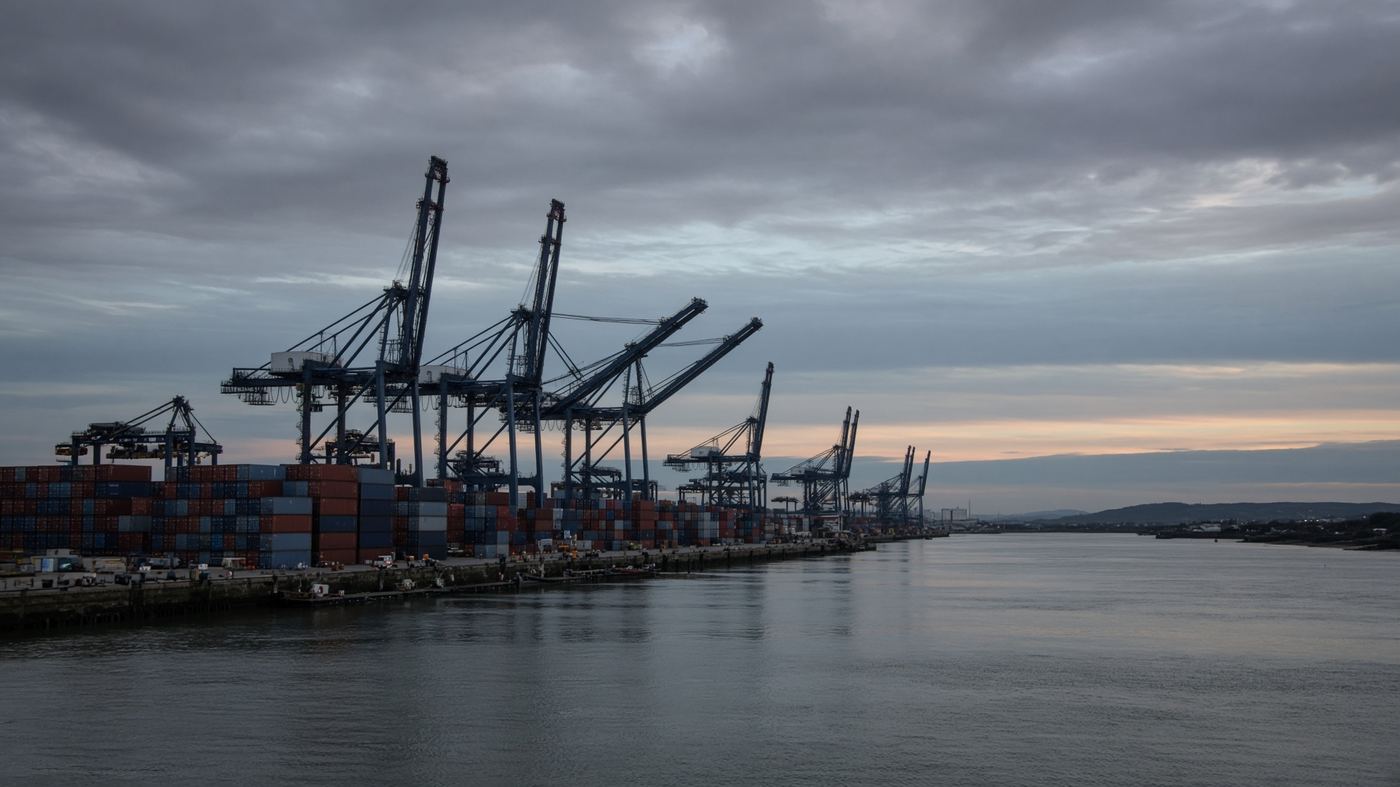
The United Kingdom’s external accounts still have the same shape they had when the withdrawal agreement was new: a services surplus sitting on a goods deficit, a goods border that did not become imaginary with practice, and a political class that would rather relaunch a reset than count lorries. Familiarity is not liberalisation. A veterinary agreement unmade is still unmade on the tenth anniversary of the referendum. A rules-of-origin form does not fill itself in because a minister has given a speech about turning a page.
Services — especially the cluster of business, financial and professional exports that London and Edinburgh actually know how to sell — continue to pay a large part of the rent. Goods, particularly those that used to move in just-in-time runs to the EU, continue to pay the border. That split is not a moral ranking. It is a description of where the non-tariff costs landed. Firms that could turn a product into a file did better than firms that still had to put the product on a trailer.
World prices are not a Brexit story, but the border still is
The Bank of England’s July report expects UK-weighted world export price inflation, excluding oil, to rise above 5 per cent in the middle two quarters of 2026, then slow. The conflict in the Middle East is part of that. AI-related demand for hardware is another. Trade diversion, the Bank thinks, pushes mildly the other way. Sterling’s effective rate has been relatively stable. None of this is because of Brexit in the cartoon sense. All of it arrives in the UK through a border that is thicker than it was in 2019, which means pass-through into consumer prices has fewer quiet routes around it.
A reset that does not move a sanitary check is a press strategy.
There is a version of the European debate that is worth having: which specific frictions, in which sectors, would a thin agreement actually remove, and what would the UK have to bind itself to in return. There is a version that is not: treating Europe as a mood board. The first version looks like chemicals, agrifood, and the Irish Sea. The second version looks like a conference.
What to watch instead of the adjectives
Watch goods export volumes to the EU against goods export volumes to the rest of the world, on a per-working-day basis, not a press-release basis. Watch whether services continue to cover the gap as professional travel and data rules evolve. Watch ports, not podiums. A country that is importing inflation through energy and world goods prices cannot afford to add a homegrown thicket for the pleasure of sovereignty theatre.
Productivity, in the companion essay, is not independent of this. A goods firm that employs a clerk to complete a form is a firm that has used an hour. The hour does not show up as Brexit in the ONS productivity release. It shows up as output per hour that refuses to look like 2007. Trade policy that takes that hour back is industrial policy, whether or not anyone is brave enough to call it that.
This essay is commentary, not advice. Sources: Bank of England, Office for National Statistics, House of Commons Library, Office for Budget Responsibility, Resolution Foundation. See the editorial method.