Housing
The housing market is still the fiscal trap
Britain cannot grow its way out of a planning system that rations land, a tax system that sits on property, and a politics that treats house prices as a household balance sheet.

Callan Reeve
Contributing economist · · 14 min

Every British economic argument that wants to stay polite eventually walks around the housing market as if it were a sleeping animal. It is not sleeping. It is the collateral for household wealth, the rationing device for who may live near a job, the quiet natalist policy, and the reason a Chancellor can raise the tax take to a post-war high and still be told there is no money. Supply is short. Planning is the mechanism. Prices are the symptom. Politics is the reason the mechanism does not move.
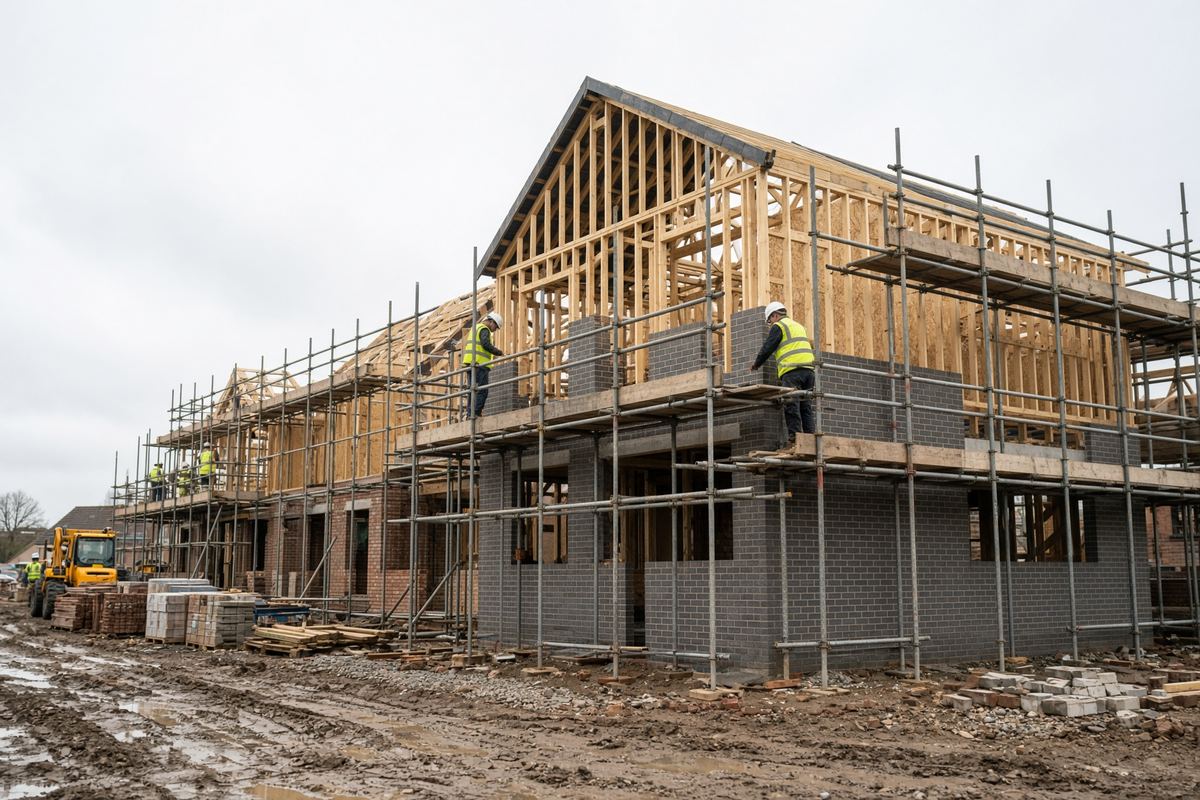
The photograph that should hang in the Treasury is not a penthouse. It is a wet street of Victorian terraces, or a muddy site where a handful of houses are going up behind fencing. England in particular has spent forty years treating land as a moral achievement rather than as an input. The result is a stock that cannot absorb household formation, a private rental sector that now functions as the residual of a failed ownership ladder, and a planning system whose delays are a tax that never appears in the Budget Red Book.
Prices as wealth, prices as a trap
High house prices do two contradictory jobs in the official mind. They are household wealth, which steadies consumption and, through housing equity, the banking system. They are also a barrier to labour mobility, a tax on the young, and a reason fertility decisions get postponed until a deposit exists. You cannot celebrate the first job on a Monday and lament the second on a Tuesday without admitting that the same number is doing both. Fiscal policy has chosen the first job for decades: council tax still mapped, in spirit, to 1991 values; stamp duty still punishes movement; VAT still sits on replacement housing more heavily than on the unearned increment in land.
A planning refusal is a fiscal decision. It just does not go through the Commons.
The fiscal trap is this: any serious attempt to tax the flow of land rents, or to liberalise supply enough to lower the path of prices, is experienced by existing owners as a wealth tax. Existing owners vote. The young, the renters, and the people who have not been born yet do not vote in the same weight. So the state raises income tax, National Insurance and, in the Autumn Budget of 2025, the overall tax take, while the asset that has done well out of scarcity remains lightly and clumsily charged.
What would count as a policy
A housing policy that is not a press release has three parts. First, land: zonal permissions around stations, a presumption that urban density is not a moral failing, and a willingness to let prices fall in real terms for a decade. Second, tax: a revaluation, a shift from stamp duty toward a recurring charge, and an end to the pretence that council tax is a localist triumph. Third, building: not a target announced at conference, but a pipeline of sites that survive contact with the courts.
None of this is a Glasgow or Manchester story only. Ayrshire has its own version: second-home pressure on the coast, a social-rented stock that does not match need, and a labour market that cannot always house the nurse it has just managed to hire. The UK housing problem is national in cause and local in symptom. Writing about it from Low Coylton does not make it smaller. It makes the London habit of treating Zone 2 as the sample frame harder to sustain.
Until supply is allowed to answer prices, every other essay in this journal is incomplete. Monetary policy leans on a market in which housing costs are sticky. Productivity arithmetic ignores the hours lost to commutes that exist because people cannot live near work. The inactivity numbers include people who cannot move to a job because the rent in the job’s city is a second wage. Housing is not a sector. It is the binding constraint wearing a sector’s clothes.
This essay is commentary, not advice. Sources: Bank of England, Office for National Statistics, House of Commons Library, Office for Budget Responsibility, Resolution Foundation. See the editorial method.